Tuesday, March 26, 2019

Medellin

Medellín, aka "City of the Eternal Spring", at 4,900 ft above sea level has a pleasant spring-like climate all year. Metropolitan Medellin is located in the long, narrow Aburrá Valley, which separates two branches of the Andes Mountains. Official and “informal” communas and townships sprawl up the mountainsides. 

The International Airport is located in Rionegro 18 miles east of the city. It is on the mountain ridge, more than 2000 feet higher than the city, and there is still no highway connecting the two. So driving to the city center takes 30-45 minutes. Notably and unsurprising, Medellín has outgrown the valley and industry is rapidly expanding to the towns to the east of the city so it isn’t hard to imagine that within a few years the highway(s) will appear.

Medellin has a public transportation system to be proud of. It includes two rail lines, a Tranvía tramcar line, and two bus rapid-transit lines with over 200 small feeder bus lines.  And to reach some of the city's informal settlements on the steep hillsides, there are five cable-car/gondola lines as well as electric stairways that climb through Comuna 13. We used some of each during our visit. And if that wasn’t enough we supplemented this with our car & driver, André. 

For our first tour day, André drove us to a convenient Metro station for the ride across Medellin (from south to north). Here we transferred to a gondola that took us up a mountain side to Parque Arvi, an area being restored to its natural habitat. The area had been planted in Pine trees to provide wood for lumber. But as with most non-native species, that had it’s downsides. It turns out that Nico had participated in the restoration of the area. He was part of the team that designed the park and later participated in creating the park. Before exploring the area, we fortified ourselves with a fruit cup of blackberries and strawberries. 
View of "informal" hillside housing from Gondola to Parque Arvi


We toured an area with orchids and anthuriums (plus lots of trees) with a guide, who along with Nico, described the various flora. 
We then headed back down the mountain and transferred back to the rail line to arrive in Centro. Exiting the train we were struck by the beauty of the Rafael Uribe Palace of Culture, a Gothic Revival style building by a Belgian architect Agustín Goovaerts in 1925. It has a distinctive black and white brick facade with rounded cupolas.
Nearby we enjoyed seeing the history of the city as depicted on a mural rescued from a building that had been demolished. The mural is protected by glass so photos were difficult to take.
From, there we wandered into Botero Plaza with it's many sculptures by the Medellin-born artist.


Then we followed a long market street where you can buy almost anything. Along the way, we stopped to admire the Centro Comercial Palazio Nacional, another architectural jewel by the Belgian architect, Agustín Gooavaerts. This former Palace of Justice has been repurposed into a shopping mall with more that 400 stores. Delightfully, the facility maintains many of the fine architectural details. 
We ended up at the old train station and inspected a fine steam engine that commemorates the former rail system. 
From there we took a light-rail line across the valley and then a gondola up the other side of the valley for lunch at Donde Dario; Pat had "Cazuela Tipica” (a tasty combo of beans, ground beef, spicy avocado, smoked chicharron and more). Bill had "Higado Encebollado" (liver with onion, tomatoes, and fresh cilantro). This was one of our tastier Colombian meals. But still, heavy to stewed meat.

Later we toured Communa 13 which was transformed by a series of events. Specifically, government intervention in the early 2000's, followed by the work of street artists and hip-hop dancers, and finally the installation of 1,260 feet of outdoor escalators (providing convenient access to the city below).  What was once one of the most dangerous places in the world (based on murder rates), now is admired by thousands of visitor a day who feel safe and awed by the art and the transformation. And while it is still a poor community, the people have hope for the future and pride in their accomplishments. 

We got to watch Choco 13, one of the most noted muralists, at work (and posing in front of his work-in-process). Later we shared one of the local specialties a frozen mango pop. Just imagine pieces of mango frozen in juice and formed around a stick. So fresh and yummy.
After returning to our hotel we decided to take one of Nico’s dining recommendations and headed to nearby Cafe Zorba. We had a very tasty Kale Pizza with pine nuts and a nice bottle of Bornada. 

The next day André took us to San Antonio Plaza to see more Botero sculptures. Here there are two sculptures of doves. One was installed in 1995 but was blown up (apparently by FARC) later that year during an outdoor concert. In 2000 Botero donated an identical sculpture but insisted both be displayed as a testament to the violence and to those killed by the explosion...whose names are carved on a plaque on the base of the destroyed piece. A very poignant combination.
From there we stopped for coffee at a renowned Tango Bar/Cafe, Salón Málaga, founded in 1957. The place is replete with memorabilia from the era (photographs of dancers, juke boxes, gramophones, ...)
From nearby we took a train to a gondola to ride up the mountain  to Comuna 8 for the views over Medellin from the southeast. Along the way we noted other murals and especially one that honored the textile workers of the city.   
Then on to see the Mercado Placita de Florez (named for the founder of the market). One of the most interesting tastings there was that of a tree tomato crossed with a blackberry. It definitely tasted like tomato but a VERY sweet tomato.  

After the market we explored the Parque Bicentenario area.  We especially enjoyed viewing the sculpture called "Arbol de Vida / Tree of Life”. It has a tree shape with the trunk and limbs formed of human bodies. The bodies are formed of many of the knives (former weapons) that were turned in as part of the peace process. 
Next we visited the Museo Casa de la Memoria, Medellín’s museum dedicated to honoring urban conflict victims. We barely saw the museum but our guide used an interactive display to walk us through the history of Medellin from pre-Columbian days tile recently. Medellin is such a beautiful city and Colombia is such a beautiful country. It is sad that the residents have had so little time to enjoy it.

The history from the conquest to recent times followed much the same path as Mexico, Spanish rule followed by independence. Mexico has had its issues with the drug cartels but Colombia ended up in a full scale internal war between the cartels, guerrillas, and the paramilitary units that were formed by the elite to protect themselves. The 1990’s were the worst times in terms of violence between the various groups throughout the country, cities and countryside fighting for control of the drug production chain from start (raising coca plants through processing and distributing cocaine). It was not until the early 2000’s that President Uribe, with the support of the populace, eliminated many of the leaders of these groups and laid groundwork for peace in Colombia. Fortunately (?) in Mexico, by comparison, the conflict between the government and the cartels has mostly been limited to regions and cities important to the flow of drugs.   

From there we were off to lunch at La Cocina de Tata. Bill had Sancocho 3D (soup with beef, pork, chicken and vegetables). Pat had Sancocho de Bagre (cat fish soup). These soups are based on yucca root, plantain (bananas), and other vegetables. They are served with rice, mango, and crepes on the side. We finally tried Guandolo, a drink made from panela (sugar cane) & lemon juice. Surprisingly refreshing. We don’t want to think of the calories. 
After lunch we drove up to Finca Catedral. This area served as the official prison to Pablo Escobar, the drug lord. And a mighty fine place to be imprisoned. Nice grounds. Watch towers to keep other out, not to keep him in. Great views over Medellin. He still managed to get killed by the the Pepes (a group hired by competitive drug lords) or the National Police or…. The stories vary. But in the meantime he knew how to “live”.  We explored the grounds, now a luxury area to live and a fine retirement home for priests. Enroute to Finca Catedral we spotted a Momotus momota, aka barrancaro, a blue bird with funny tail; The name barrancaro refers to the fact that it builds houses by burrowing into cliffs. The bird was impressive but hard to photograph.

Above: Murals on buildings within Escobar's prison.
Below: View over the soccer field at the prison,

The next day was a “leisure day”. We started by exploring the Poblado neighborhood, the area where we were staying. There are lots of restaurants and shops in the area. It was Sunday so not all shops were open but the first one we found was Pardo, a men’s shop and we immediately spotted a shirt for Bill. 

Later we decided to have lunch at Romero. We shared a Caesar salad. Bill had pasta with four cheeses and Pat had risotto with mushrooms and a bottle of Dada Art Wine 3 (Cabernet Sauvignon & Syrah) from Finca Las Moras in Argentina. 

From there we walked to Santefé mall. Mind you there is a Santa Fe Mall and a Santafé Mall. We started out for the former which was quite an uphill walk before we realized our mistake. In any event, we finally arrived at our targeted mall. It is quite impressive. We explored a little and then returned to our hotel. 
Later we decided that to return to Romero to have for ice cream It all looked so good, but we just couldn’t manage it at lunch. So now was the perfect time. Bill ordered a cone of “lemon pie” and "white chocolate”, Pat had pistachio and maracuya / passion fruit.
The next day we were off to El Peñól, Guatape and the local lake (Penol/Guatape reservoir) formed by the dam built in the late 70’s. It is about a 2 hr drive from Medellin. Along the way we took a rest stop and tried some  local pastries, Pan almojabana. Our driver called them Colombian Doughnuts. Wonderful light bread dough fried in rings. 
Then we were on to visit the new town of El Peñól. The new town has little character as it was built under duress by the utility company when they were forced to provide homes for the folks displaced when the dam was built. The main places of note are the local cathedral, built to look somewhat like the Rock of Peñól in nearby Guatape and a little cafe that served really great empanadas (triangles of dough with meat filling).
Above: Cathedral build a a replica of Rock of Peñól.
Below: Fine empanadas.
We continued on to Guatape where we climbed more than 700 steps, carved into the northern face, to the top of El Peñól (Rock of Guatapé) peak to the viewing platform (with a few rest stops along the way). Even the young guys were breathing hard on this ascent. Views along the climb and at the top were impressive despite the rain and clouds. The rock rises from the bottom of the hydroelectric dam of Peñol-Guatapé. At its highest part it has an elevation of 7,005 feet above sea level, towering up 650+ feet above its base. 

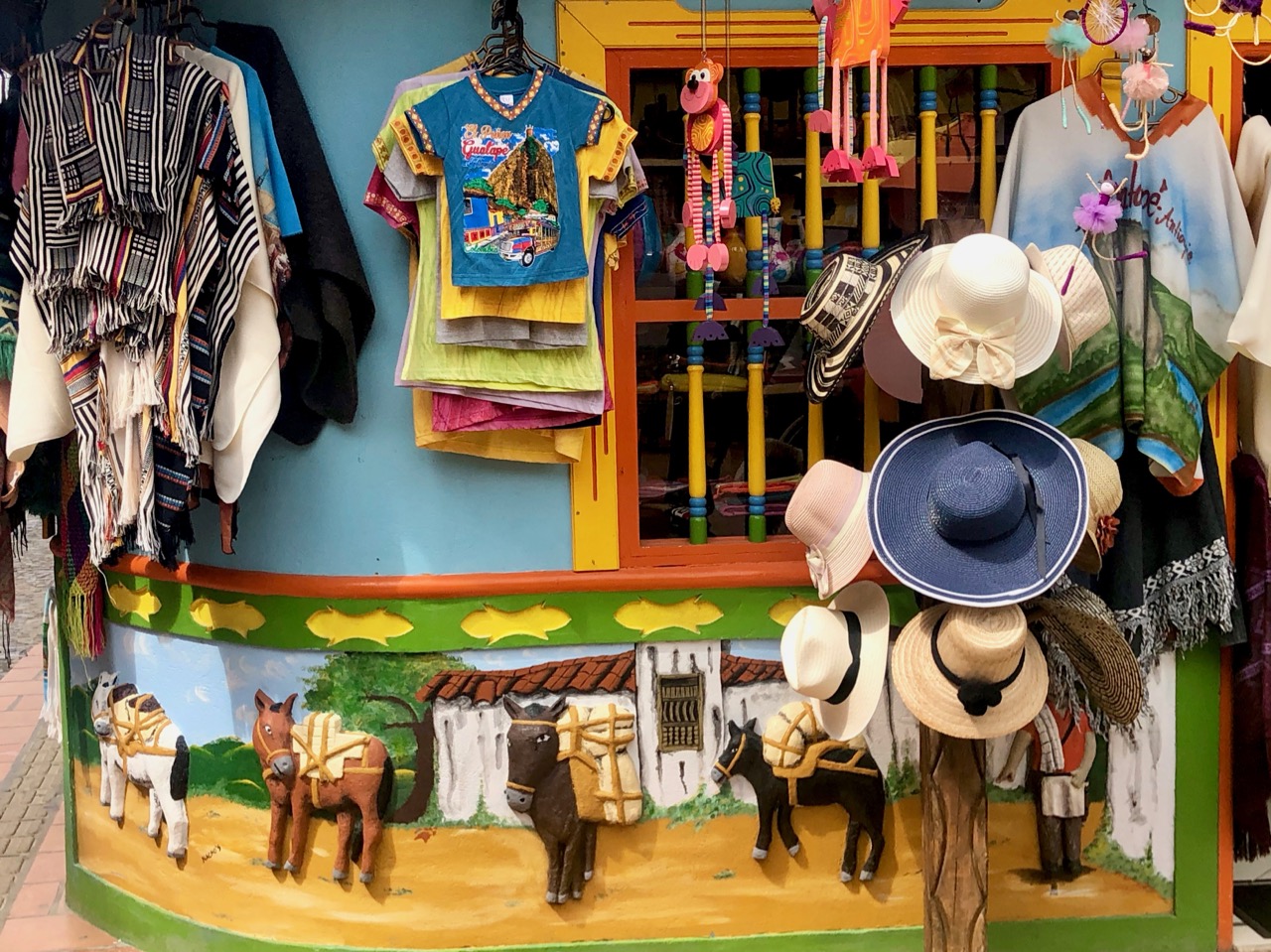
From the Rock we were off to Guatape for lunch and a walk around town. The town is quite cute and the exterior walls of the buildings are decorated with what they call “zocolos", decorative strips on the lower part of house /store exteriors.

We had lunch of grilled trout, one with and and one without garlic.The garlic one was almost too heavy to garlic, if you can imagine that. The fish and Sauvignon blanc from Chile were excellent. After we explored town some more, we shopped a bit(we bought a couple of gifts) and checked out more zocolos before our boat ride around the lake.  Along the way we made another “narco Tourism” stop at the remaining grounds of Pablo Escobar’s estate (not to be confused with his prison). The grounds were impressive, despite the fact that they are in total ruins. As mentioned earlier, the man seemed to know how to enjoy life, despite ruining it for so many others. Today a portion of the grounds is used for paint ball competitions. 
Above: Ruins of the home.
Below: Paintball grounds.
In the evening we went to Bonhomia for light dinner (plate of 3 deli meats and 2 cheeses with bread) and a bottle of Muga Rioja.  All good and just the right amount. 


Our last day in Medellin we spent blogging, getting laundry done, shopping (buying two pairs of jeans for Bill) and having a light lunch at Greek Connection where we enjoyed the greek salad and fried calamari with a glass of white wine. We were saving space to enjoy dinner at Voila Vinos, a French restaurant started as a way to encourage Colombians to enjoy French wines. So at dinner we did our best to enjoy French wine…starting with a cremant (sparkling wine from outside the Champagne region) with foie gras, then moving on to a red Languedoc to accompany our veal and rabbit, and, finally a Andre dessert wine from Gascony to go with our profiteroles with “red fruit” sauce for dessert.  A very nice evening. 


Wednesday, March 20, 2019

Adventures in Villa de Leyva and Barichara


Villa de Leyva is  known for its whitewashed colonial buildings, cobbled lanes and vast Plaza Mayor. 
For our first exploration in Villa de Leyva, we opted for a roundabout walk to the outskirts of town to see Casa Terracotta. Along the way we enjoyed seeing the range of houses, mostly all white with some terra-cotta. Many had balconies and windows sporting carved wood, and looked like they could have been transported from the Alps.  

Pat spotted a lovely flower that was totally new to her.  Maybe someone will see the photo and identify it.
Casa Terracota is a whimsical clay house created by Colombian architect Octavio Mendoza. It is mostly built of clay without any supporting beams.  Our guide happened to have a friend who lived next to the property. He recalls a number of early attempts at developing the technique simply collapsed. Inside the house includes clay benches, clay beds, clay shelves, clay everything. The bathrooms add some colorful tiles which made us think of Anado McLauchlin’s work. For those of you who do not know Anado, see: madebyanado.com    


We took a shorter route back to town and then went to lunch at Mercado Municipal. Bill had the Barbacoa Lamb and Pat had the Mushrooms. The lamb was prepared like confit and accompanied by some very al dente vegetables and rice. Pat’s mushrooms were seasoned with garlic, chili, wine and sesame seeds. The wine, a Bonarda from Argentina, was still a bit young but mellowed nicely over the course of the meal.

After a little siesta we went back outside of town to see the 17C Dominican convent which hosts a collection of religious and colonial art. Unfortunately it wasn’t open so we explored the grounds a bit and found a small cemetery with a sentinel who has been sitting watch for a looong time.
We next headed to the fossil museum which is under renovation and the star attraction, a Kronosaurus is all covered with blue plastic. That Kronosaurus is a Cretaceous-period (more than  65.5 million years ago) relative of the crocodile. We were especially sorry for a young French couple we met there who had walked all the way from town, about an hour, without a glimpse of the fossils.  

We next decided to check out pre-Columbian Archaeological Site, El Infiernito. And wonder of wonders, it was open! It features several earthworks surrounding a group of menhirs (upright standing stones), as well as several burial mounds. It was likely a center of religious ceremonies with a rudimentary astronomical observatory.


We had dinner at a small Italian place, La Ricotta, Carbonara for Pat and Gnocchi with Four Cheeses for Bill. Believe it or not we each had only one glass of wine. 

On our leisure day, it was kind of drizzly so we slept in and worked on our blog until joining Alejo for lunch at La Feria, where we enjoyed several Colombian dishes. Lomo Fino de Res a lo Cachaco (beef tenderloin strips), Pechuga de Pollo a la Brasa (grilled chicken breast), Plátino Maduro (cooked ripe banana), Arepa de Choclo Casera (a bread made of corn meal & fresh corn stuffed with cheese), Envueltos de Mazorca (a polenta like filling enveloped and cooked in a corn husk), and Papas Chorriadas (potato wedges with cheese sauce). All accompanied with Colli Euganei Rosso wine, a red blend from the Veneto.

In the afternoon, we shopped around and found a couple gifts. Later we dined at the Spanish restaurant, El Rincon Gourmet. We selected a couple of tapas: Abondingas (Meatballs), Patatas Bravas, and a bottle of Riscal Tempranillo. There was a lovely crenelated candle holder that added a romantic touch.
The next day we were off early for Iguaque National Park. The 6,750-hectare area is a sanctuary of the Muisca indigenous people and a protected reserve for local flora and fauna.The hike is 4 km (2.4 mi) distance and about 800m (2700ft) in elevation. It is a strenuous hike that leads to a sacred lake where the Muisca people believe life began. To assure everyone returns before dusk, the trail closes to new climbers at 10 am. We were off by 9:59, honestly. 

It was a drive over rather rustic / primitive roads for 1/2 hour to get to the trail head...a fitting approach to a similarly rustic / primitive trail. The initial part of the trail is paved with large stones which sounds nice but it wasn’t a smooth surface by any means. As we hiked through the forest, Pat enjoyed the plants/flowers/ leaves... After a short ways the stone paving ended.
Our hike was cut short by rain making the unpaved trail slick and muddy. We did stop back at the entrance to enjoy our picnic of cheese, meat, and bread.
Our evening meal was at La Cocina de la Gata, where we enjoyed French Onion Soup and Cheese Fondue with a mixed salad, a fitting meal for a cold drizzly day.
It was roughly a 4 hour drive from Villa de Leyva to San Gil where we stopped for lunch at the restaurant in Parque Natural El Gallineral. We observed or were observed by a blue macaw as we ate. We chose the Tipicos Gallenras, a large meat sampler with "pollo, sobrebarriga, carne fresca de res, carne oreada, cerdo, chorizo with yucca y arepa santandereana". Make that chicken breast, and grilled flap steak / sirloin tips, some other fresh cut of beef, a smoked thin beef cut, pork loin and chorizo sausage with yucca root and local little corn cakes stuffed with some fresh cheese. As if this wasn’t enough, we had two appetizers: Cebollitas Ocañeras Piquantes (small pickled onions) and Patacón with Hogao sauce (banana this time in a small pancake form with Hogao sauce) Note: Hogao is the non-spicy Colombian sauce served with most dinners, similar to a non-spicy Mexican pico de gallo salsa.


After lunch we did a short stroll around the park. It was especially cool to see the wedded trees... Around 300 years ago a Ceiba Tree and a Fig Tree joined at the roots and have since lived a long happy life (we assume) together. 
From there it was a short drive to the start of our bike ride. We last biked in Bali (another downhill route). We discovered bikes gears have evolved significantly, in a good way, at least Pat thought so. She really liked how simple it was to think in terms push with right thumb to gear down for climbing hills (yep, there were a couple) and pull with your index finger to gear up. Pat’s bike was a bit higher than she was used to so it took a few tries to master getting on and off, but we were soon off for another mostly downhill bike tour. Along the way we stopped to visit craftsmen (basket-makers and stone carvers) and for a few views before arriving in Barichara for a sunset snack looking over the valley. 
 The snack? It started with roasted & salted “big-butt” ant eggs, aka "hormigas culonas,"  a seasonal delicacy in Colombia...crunchy and tasty. We also had toasts, fruit (tangerines & pineapple, both sweet and flavorful) and coconut covered jellied guava candies.


After the snack we walked over to Casa Barichara where our luggage was waiting for us in our room.

We settled into our room and then wandered down to the town square with Alejo. None of us were was especially hungry but we decided we should have a small bite. We chose to eat outside on the plaza at the Terra Barichara Hotel. A flatbread pizza and a bottle of Bardolino split 3 ways was the perfect amount to tide us over til breakfast. Wandering around town, we noticed the fleet of taxis. 
The next morning we slept in and lazed around the room. Then we headed out, stopping first for some photos as the nearby Capilla de Santa Barbara, and then shopped our way down hill. We especially liked a leather shop and the basket shop with products made of fiche fiber. A fiche plant is similar to a giant agave. 

We ran into Alejo along the way. He recommended that we have lunch at Noa’s. Their speciality is Fagottos (wraps using a pita type bread). Pat’s was stuffed with beef tenderloin, onion confit, mushrooms, roasted pepper, white cheese and arugula. Bill had one with serrano ham, mozzarella, fresh & dried tomato and arugula. Both were great and went well with a French cabernet sauvignon. While we were eating a French couple sat down at the next table. We ended up in a great conversation that mixed Spanish, French and English. I suppose we all tried to use Spanish, our common language. But whenever we couldn’t find the right Spanish works, a French or English version seemed to work just fine.  What fun!
After lunch we hiked down to the valley below following a rustic stretch of the Camino Real (the Royal Road) to Guane village. Along the way we enjoyed the views, the cattle in the field (mostly Brahma) and the birds. As we arrived into Guane the road became more of a cow/goat path than a road, but shortly we turned onto a town street with fewer animal droppings... Guane is a very small town but of course has a nice church. It also had a colorful tourist bus parked in front of the church.


That evening we walked to a small Italian Restaurant, Ristorante de Cocuo. The wine list consisted of 4 or 5 fine wines that were set our for our selection. We chose the Pascua Sangiovese Puglia. The bottle looked as rustic as the trail we had hiked earlier. The wine was pretty fine. Bill had pasta and meatballs. Pat had pasta and Italian sausage. The fettuccine was a rough homemade style and cooked al dente. Just to our taste! 
We had had breakfast in the garden under the shade of a tree. While eating, Pat had noticed several very large buds of a Pittaya (Dragon Fruit) plant that was draped over the tree branches. Arriving back at the hotel, Pat remembered to check out the Pittaya Plant. Perfect timing. The blooms were gorgeous. But by 7 AM, they were closed up and ready to fo cus on producing fruit.


Casa Barichara is a lovely B&B with relaxing grounds. The staff members were all very gracious. Breakfasts were ample with eggs cooked to your preference. One morning Bill ordered the "traditional Colombian" breakfast with chorizo, arepas (the bread) and a corn pudding wrapped in banana leaf. And the napkin rings were cute. A range of little animals from cats to giraffes and warthogs. And they did our laundry...all by hand! 


In the morning, we were off to see the Juan Curi Waterfall in San Gil. Following a nice hike past some farmlands with chickens, roosters and peacocks, we approached the falls. As we got closer the terrain got more rocky and a bit tricky to navigate. We arrived at the base of the 250 foot high falls to learn we had the option of climbing to the top and rappelling down. We decided it would be wiser and safer to watch others have that fun. We returned to the trail head along the same trail but stopped along the way to observe the mules. We don’t know if it is typical worldwide, but apparently Colombian mules tend to have striped hind legs (like a zebras legs).


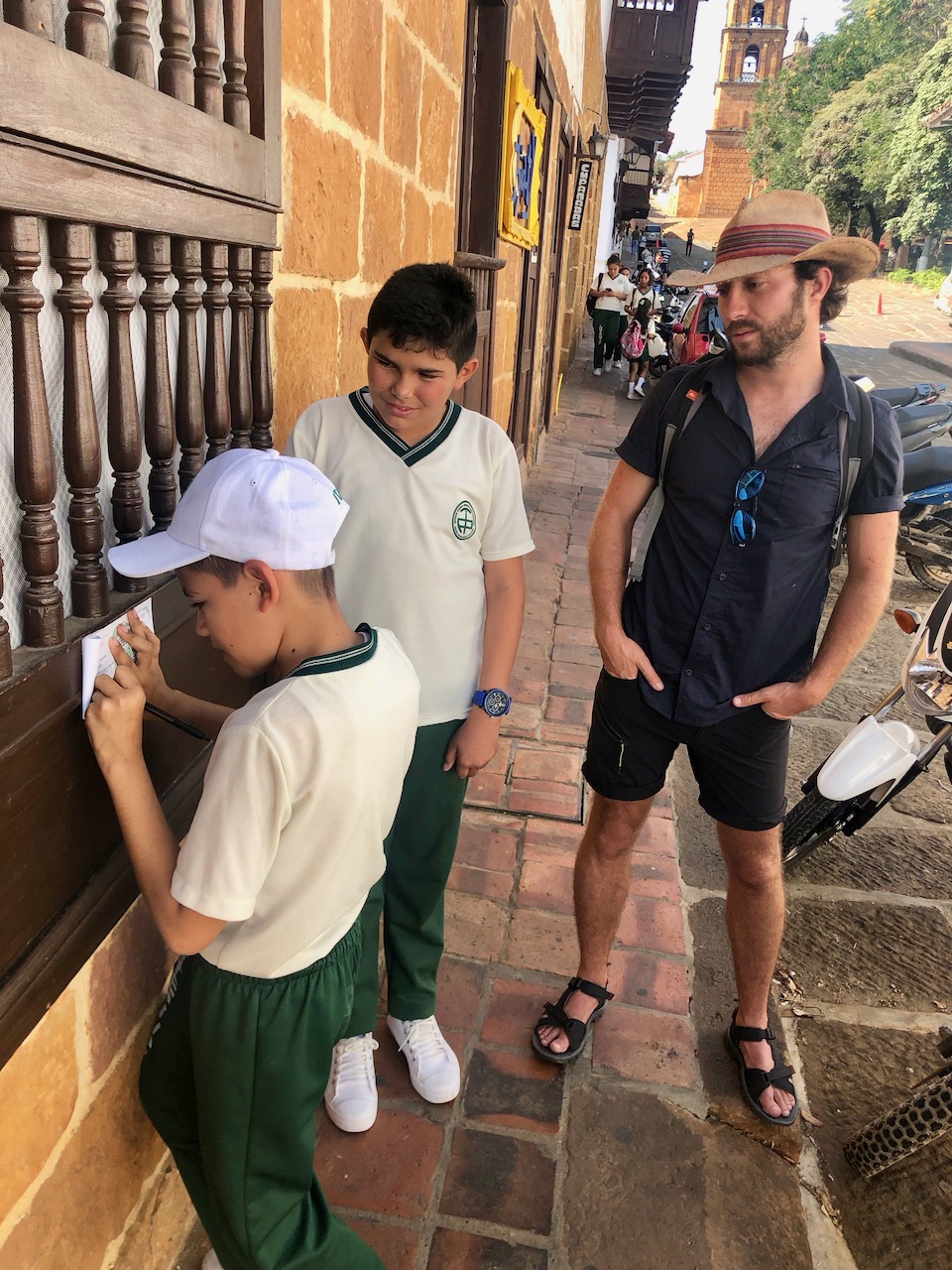
Returning to town, Alejo joined us for lunch at the Italian Restaurant we had visited the night before. This time we shared a pesto gnocchi and a Ruffino Chianti. After lunch we explored town a bit more. As we wandered we were encouraged by the local students to buy lottery tickets. Alejo helped us come up with a strategy for deciding who to buy from...the first kids who would try to talk to us in English. Some either couldn't or were too shy. Finally a Venezulan helped his team and they managed a little English and we had to pay up. 
Our evening meal at La Nube Posada was quite special. We started with tabule salad with peppers, tomato and parsley. Very refreshing. Next up was Lomo de Res Quemado”, beef tenderloin with mustard sauce. This included a very tasty chayote & mango salad. For dessert we had mango again. This time roasted with vanilla ice cream on the side. 

The next day we had a 7:30 pm flight to Medellin. This left ample time for rafting in the Fonce river. It had rained a little overnight so the river was a bit high. This delayed our start briefly but apparently the runoff runs off quickly. Still, this allowed us time to stroll around the center of San Gil. In the Plaza Mayor there is an interesting statue of an Indigenous Chieftan with wings and a condor head sprouting out of his chest. This was apparently a chief who ended up escaping the enemy by jumping off a cliff and transforming into a condor. 
In addition to our raft there was a guy in a kayak who checked the rapids ahead of us. Nothing like being coddled on an adventure rafting trip. Before heading out we had training re how to steady ourselves on the raft, what to do if we went overboard, how to get back on the raft, how to work with the kayak if they had to rescue us... It turns out the more useful coaching tidbits were the terms directing us how to paddle, what to do if we were heading into a big wave and how to help steer the boat by all getting on the same side. Later when we followed directions well and we got through the big water without mishap, we would high-five with our paddles.


At one point our guide really liked the action of the water and he directed us to keep steering back into a wave and then he would advise us all to duck as the water washed into the raft. The cool thing was that Bill & Alejo were in the front and they took all the water so Pat stayed quite dry. What gentlemen!

After the raft trip we were able to shower and make ourselves presentable before going to lunch at Teté Fileté in San Gil. The four of us shared and order of Monster Fries (French fries with chincharron / fried pork skin). Very healthy, no? For his main course, Bill ordered the Brocheta Mixta (a skewer with pork, onion, tomato, served with a rack that reminded us of what we had in Capetown some years ago. Pat chose the BBQ Pork Ribs with Sesame / Honey Sauce. Both were excellent.

Then we were off on the 3.5 hour drive to Bucaramanga airport for our flight to Medellin. It is a long, windy road with some construction and a lot of truck traffic. Checking directions on Google now (9pm), it looks like a 2.5 hour drive. The highlights of the trip was that we drove along the Chicamocha Valley (a large canyon) and the bird that posed for Bill once when traffic was at a standstill. 
The 40 minute flight got us into Rionegro. We were met at the airport by Nico (guide) and André (driver). From there it was a 40 minute drive along the mountains to get to our hotel in the La Poblado district of Medellin.