Thursday, September 21, 2017

Amazonia


Preparing for our visit to Reserva Amazonica, we reorganized our bags for the move DOWN roughly 11,000 feet to the Peruvian headwaters of the Amazon. We flew from Cusco to Puerto Maldonado. We were met at the airport where they sorted everyones bags into the ones to go on the boat for use at the lodge and the ones to be stored until our return.  

We knew we would be roughing it because there would be absolutely no Internet and limited power access during our stay. Mind you otherwise everything at Inkaterra Reserva Amazonica is pretty high-end. Upon arrival we learned that power was off daily from 3:30pm - 6pm and 11pm to 4am. 

You might wonder why it comes on at 4am. We found out. One of the morning tours requires rising at 4am in order to get to the site before the birds arrive. Other tours require rising at 5am. Enjoying nature does require some sacrifices. Sigh. 

Having arrived at 2pm, the first order of business was lunch. There is a very fine lunch menu. To illustrate, Bill chose:

  • Starter - Palta con trucha curada y sachaculantro / Avocado with cured trout with cilantro
  • Main - Panceta de credo a baja temperatura laqueada con maracuyá y mango / Low temperature pork belly lacquered with passion fruit & mango;  
  • Desert - Tarta de chocolate con salsa de chocolate y crema / chocolate tart with chocolate sauce y whipped cream.  

And Pat chose:

  • Starter - Ceviche de Paiche / Paiche ceviche
  • Main - Ñoquis de plátano, hongos portobello, aji dulce y vino blanco / Banana gnocchis, portobello mushrooms, sweet pepper and white wine
  • Desert - Tarta de chocolate con salsa de chocolate y crema / chocolate tart with chocolate sauce y whipped cream.  

Admittedly there were a couple other dessert options, but that chocolate tart was REALLY good.

We learned they were serious about turning off the power at 3:30 because they were unable to make espresso to go with our dessert.
After a quick stop at our cabin, we went down to the orientation center to plan our tour schedule. There are 3 nighttime tours, and a range of daytime tours. Our guide guided us through the options. Some choices were quite simple and obvious. A few tours, like the ornithology tour cost extra and required 4 participants. We were happy that Peter & Suzanne, a German couple, wanted that tour as well.  

Our day 1 nighttime tour was "Rio de Noche /Twilight River Cruise" from 7pm -8pm. On this boat tour we enjoyed the brilliant nighttime sky and waited for our “spotter” to locate the nightlife with a powerful spotlight. We saw black caymans. white caymans (caymans are basically the local alligator), and various nocturnal birds.


Upon our return we were invited to dinner.  Not being very hungry after that late lunch we “tasted" dinner rather than “ate” dinner. Then we were off to prepare for our 5am wake-up call.


Dawn, whoops earlier than dawn…it was our wakeup call. We quickly dressed, slathered on sun cream and bug cream and hurried down to breakfast. Then to the boat dock. We were off to visit Lake Sandoval. As we boated upriver, we saw a mineral lick covered with parrots.  We learned that mineral licks provide essential nutrients for parrots and macaws; as a result we get to enjoy the spectacle as they crowd around the lick absorbing these minerals.  

We also spotted a capybara (the biggest rodent in the world)


and a white cayman.


As we walked to the lake we skirted around a termite mound and paused to enjoy bright red funghi. 


Af
ter a 2.5 mile (muddy) walk, we reached the boat dock. Our guide paddled us through a canal to the lake. The lake was very still and we enjoyed the reflections in the water. 


As we paddled around the lake we saw: a black cayman, 


birds,

bats,  
more birds (this time macaws)

turtles,  

and butterflies.  Actually we saw a mass of butterflies when we arrived back at the boat dock but it was difficult to get a good photo.  Apparently, just like the parrots and macaws, butterflies like certain minerals and there was a small area of beach that attracted them...but despite their large numbers, they don't show up that well in our photos, so you'll have to settle for this shot.


We arrived back at the lodge around 11am, showered and after a short rest went to lunch. We were planning to take the 2pm canopy tour but while at lunch we got heavy rains. When the rains let up we went back to the cabin for a bit more rest. 


Around 3:30pm the rains stopped and we were off for the canopy tour. Towers about 90 feet high bookend a series of 7 rope bridges otherwise supported by trees. Yep trees taller than 100 feet and strong enough to support the towers at that level. It was cool to walk through the canopy (although a bit scary…)


We were back in time for Happy Hour and dinner. Such a tough life. 

We were up at 4am for our ornithology tour.  A 1.5 hour boat ride to another mineral lick on the river bank popular with parrots and macaws. The birds carefully scout out the location from the treetops. Once they are confident there are no predators nearby they attack the mineral lick en mass. So we waited a bit watching the birds in the treetops. The birds were quite skittish so we boated past the area several times before succeeding in seeing them on the lick.  Our guide setup a powerful telescope and took the following shot through it with Pat's phone. 


Bill got this shot with his zoom telephoto camers (hand-held).  That man has one steady hand.

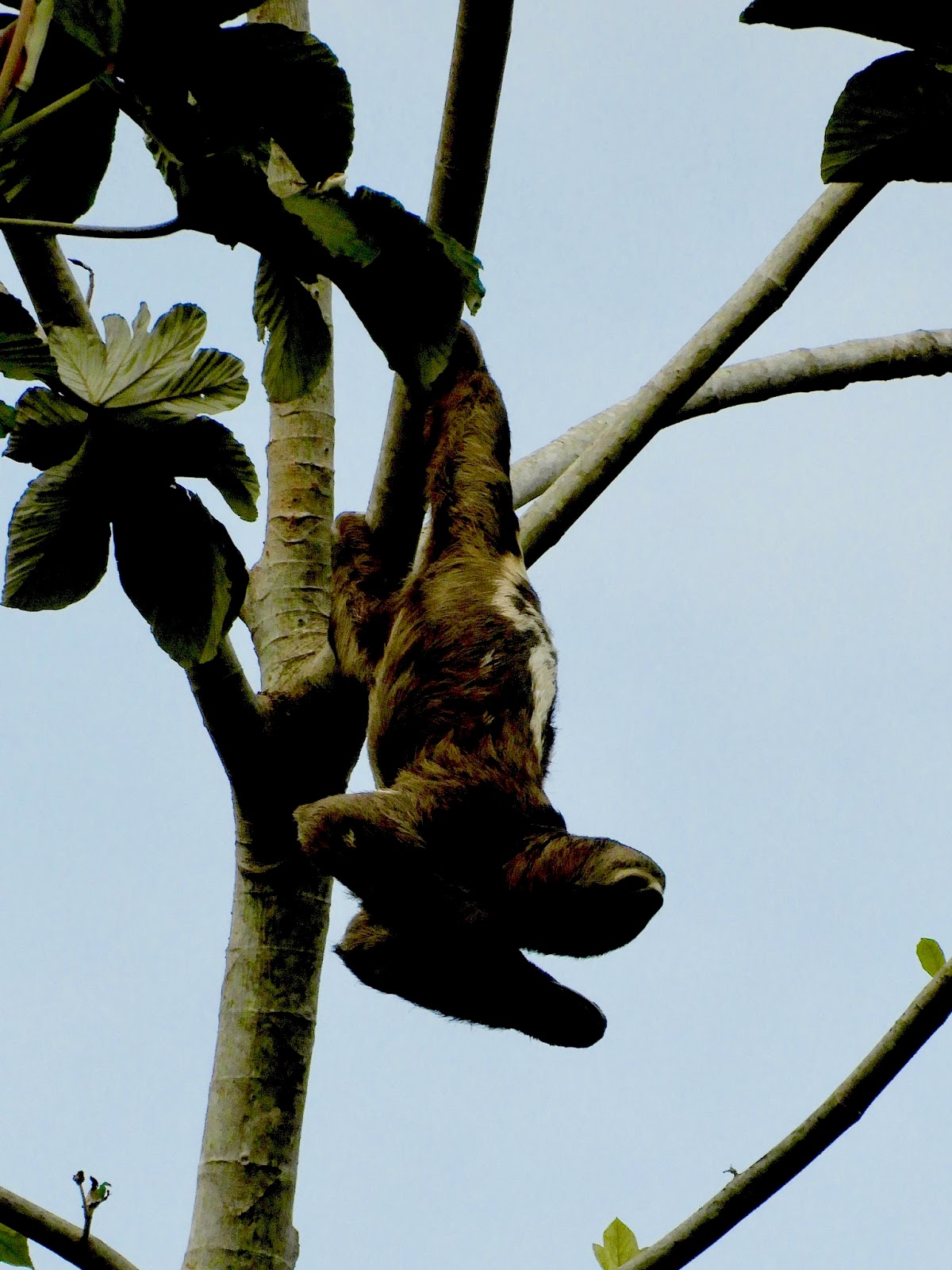
After breakfast on the river, we headed back and were delighted to encounter a couple sloths on the river bank near Puerto Maldonado. Study the photo and you will realize that the sloth is hanging upside down. 


After another fine lunch and we headed to Hacienda Conception, another resort in the Inkaterra collection.  Along the river between the resorts we saw Macaws in the treetops. 


On this tour we visited the Garden and learned how Brazil nuts are harvested and processed. We learned that a large casing for the nuts is about softball size and contains anywhere from 12 - 25 nuts. This larger casing is hard to open and usually takes 2-3 whacks with a machete.  


After exploring the garden we went of a boat tour of the lagoon where we saw a family of Red Howler monkeys, 


some small yellow birds, 

and many larger, colorful “Stinky Birds”.


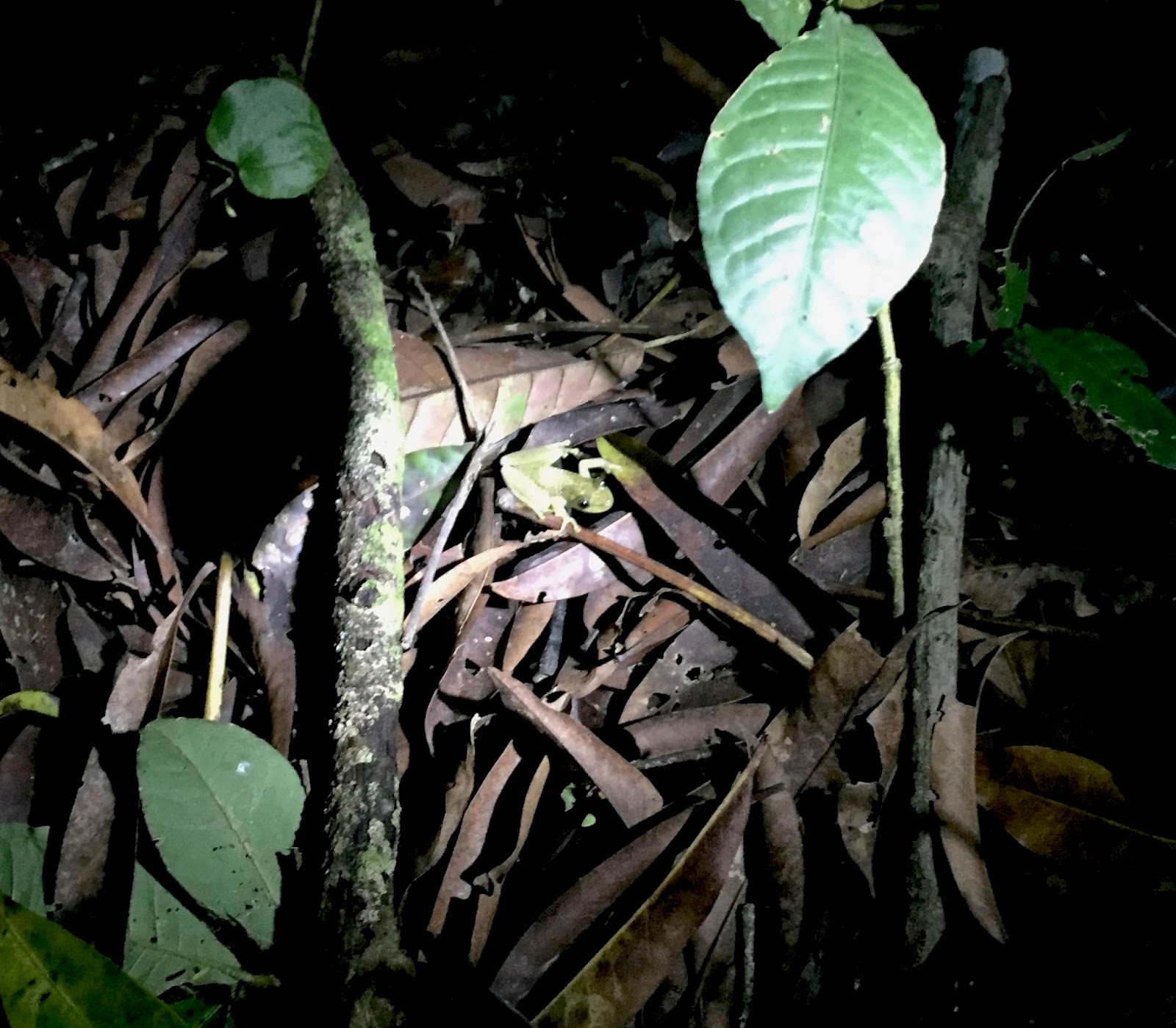
Happy hour. After a Pisco sour Pat went on the Selva Nocturnal / Rainforest by Night tour and Bill had white wine and talked with some new friends, Tim & Heidi, from St Louis. The tour started with a visit to Rosita, the black fuzzy tarantula who lives in a tree near the orientation center. Other sightings included numerous smaller spiders, a white & brown (but not so fuzzy) tarantula, and a small yellow frog. Oh and there was a MASSIVE ant hill. It was more or less just at ground-level, roughly 20 feet in diameter wide and, we were told, it was roughly 7 feet deep. 


Here is Rosita the tarantula, hiding behind a twig.

And here's the tiny yellow frog.

In the morning after a few photos of the resort, as well as animal and plant life, we are off to Chiclayo and to explore pre-Incan history.


Just before arriving at the airport, we stopped to visit the Butterfly house.


In the morning after a few photos of the resort as well as animal and plant life we are off to Chiclayo and a little pre-Inca history.  

Tuesday, September 12, 2017

Back in Cusco

Weight wise we have been doing well. But with our return to Cusco that will likely change. There are MANY fine restaurants here and we plan to make the most of it.

We started our local touring at two Inca sites: Saqsaywamán and Q'enqo. Both were made of large boulders (from a few hundred to several thousand pounds) and in Incan fashion, all carefully chiseled out to fit together with only extremely narrow seams. It is hard to picture how this was accomplished with only manual labor...but there are theories about ramps and rolling the rocks on logs or round rocks.


Just think about how they got that stone on top of this gate...

Later in town we visited the Cathedral,
 built using blocks pilfered from the nearby Inca site of Sacsaywamán. The interior of the Cathedral was impressive because of the massive amounts of glitzy silver and gold side chapels. Drat no photos allowed.  But we bought a couple postcards. 
Choir stall, copied from the cathedral in Toledo
There is also a wealth of artwork featuring the Cuzqueña School (combining of 17th-century European religious styles with the local colors and sacred symbols of the Incan culture). One notable piece is that of the Last Supper where instead of feasting on a sacrificial lamb, they are feasting on a Viszacha, the wild Andean chinchilla...sacred in Andean mythology. Note: It is often stated that they are feasting on Cuy (guinea pig), either way you get the picture. This is not the European view of Catholicism. ;-)

Last Supper, copied from a postcard.  
Our final stop was at the Church of Santo Domingo, built on top of the Temples of the Sun and Moon, typical of the Spanish conquerors. A few remnants of the temples can be seen around the church and convent.

That dark round protrusion on the righ MAY be a portion of the temple of the sun.

From there we said good-bye to Harry and went for lunch at Papachos, a Gaston Acurio restaurant where we had Tapitas Papacheras (bruschetta with "bacon, elderberry, cheese, sour cream and spearmint sauce, and a hot rocoto pepper sauce."  Bill had the Porteña burger (with "cheese, avocados, sauteed onions, parsley & garlic chimicurri, lettuce & tomato"). Pat had the Mac & Chis made with "Paria Andean cheese with a spicy bite".   


Saturday we visited the MAP museum of pre-columbian artifacts. Pieces in the collection date from 1250 B.C to.1532 A.D. with galleries reflecting works of the major cultures of Peru including Nasca, Mochica, Huari, up through Inca (starting with the earlier cultures). We found the artwork interesting, some pieces seeming quite primitive and others, like these two bottles, from the period 1250 BC to 1 AD, more contemporary.  


And how about this set of earrings!? Yep, they are about 4” in diameter and go in the earlobe.


After visiting the museum we went to the Fallen Angel, a restaurant with funky decor and excellent food. The photos are the best descriptors of this unique eatery. 

Our complementary starter (kalmata olives with marinated cheese cubes)

Asparagus Quinotto - made with asparagus accompanied with oyster mushrooms, artichokes and lake algae
Vegetable Melody - grilled pumpkin & beet slices, with baby onions in pisco and red wine syrup, fresh orange wedges, huacatay oil and tree tomato vinaigrette
Bill had "Rainbow crusted trout- rainbow trout in a caper crust with piquillo peppers. Accompanied by new potatoes, snow peas, asparagus, broad beans, stir fried capsicum and crunchy prosciutto."  


Chocolate bomb - An explosive chocolate and hazelnut coulant, accompanied by a scoop of lúcuma ice cream with a raspberry and strawberry syrup.  Drunken pear - soft pear marinated in red wine,  stuffed with kiwicha and custard cream, and enveloped in puff pastry, accompanied by Andean mint, chia and pistacho ice cream with plum coulis.
What happened to those desserts???
The funky decor includes a metal angel and glass tables supported by bathtubs with resident gold fish. Note the heart stuffed seating and the 4-eyed cat eyeing the goldfish.

The San Pedro market was our next stop. The large area has stalls offering clothing, fruits, vegetables, meats, and a lot more.  As with any market you can get lots of cool photos, but our favorite is this mix of corn.


As we were leaving the market, a procession was approaching the local church. We stopped to watch and compare the local festivities to those in San Miguel. A lot of similarities.


This group was well supplied with Cusqueña beer.
That kid on the left sure hops high!
Not sure what he represents, but he is definitely colorful.


Sunday we visited the Museo de Historia Regional which follows the history of the area through the Incas and Spanish. It is an eclectic museum housed the home of the Inca-Spanish chronicler, Garcilaso de la Vega...the son of a Spanish conqueror and an Inca noblewoman. He is recognized for his chronicles of Inca history, culture, and society. The chronologically arranged collection begins with arrowheads from the Preceramic Period and continues with ceramics and jewelry of the Wari, Pukara and Inca cultures. The final exhibit is on the life of Garcilaso, also very interesting. Again, no photos. 

Then we returned to Cicciolina. Remember last Sunday’s promise for more on this restaurant? We began with an "Arugula & fresh basil salad with duck proscuitto, goat feta, pickled baby onions, roasted tomatoes, and sugared almonds. It was served with grained red quinua drizzled with a green olive dressing".  


Bill had "Fillet of Alpaca with a creamy 4 pepper sauce. Served with crispy yuca soufflé and roasted tomatoes". The fillet was AMAZINGLY tender. Pat’s choice was "Cracked pepper pappardelle tossed with a salsa of smoky grilled chicken, roasted onions, sweet zucchini, peppers, mushrooms sautéed in dry white wine and creamy parmesan. Topped with fried garlic slices". Pat rarely orders chicken and she far prefers dark meat, but this white meat was juicy and extremely tasty. A good choice. The wine, Intipalka Tannat.  


To finish the meal "a white chocolate mouse mounted on a soft whisky brownie. Drizzled with warm butterscotch sauce, sprinkled with toasted chia & served with little mint jellies". Oh, and we also had Oporto Malamado from Argentina.


Pn our way back to our apartment we encountered some more local color...local dancers waiting for the their part in another procession.


Pat liked this sign and plans to take it seriously. Oh, wait. She already has.


 Shortly before reaching our apartment, we noticed this fountain in Plazoleta San Blas.


And here is the view from our apartment...Note: There are MANY steps to get to the Boutique Hotel and then more to our Penthouse apartment. Depending on the route from the town center, there are 100 or more step to the driveable street near our apartment. Then there are 40 steps up to our building and 42 more to our apartment.  Consider it part of our exercise routine.


On Monday, we first visited The Museo de Pisco, an excellent tasting room and tapas bar. It was a great place to get educated on Pisco while having a light snack. 

Pisco is a colorless or yellowish-to-amber colored brandy produced in Peru and Chile. Made by distilling fermented grape juice into a high-proof spirit, it was developed by 16th century Spanish settlers as an alternative to brandy that was being imported from Spain. It had the advantages of being produced from abundant domestically grown fruit and hence avoided the need to transport the drink from Spain and up to remote high-altitude regions.

Our knowledgeable Pisco guide, patiently described the types of Pisco and how they are produced. He also provided a great charts with provided much information on the history as well as the making and styles of Pisco. Our favorite of the tasting was a Torontel, made from torrontes grapes. We were particularly taken by the jasmine & peach characteristics. 


We had planned to visit the Museo of Popular Arts to learn more about the local crafts. Apparently it is quite small and has erratic hours.  In any event, it was closed. We moved on to the Museo de Inka. 

The Museo de Inka provided another lesson on pre-Inca through Inca cultures, as well as the Spanish conquest and its impact on the culture. We are slowly getting better at recognizing some of the many early cultures of the area. The displays feature pottery, jewelry, weavings, mummies, dioramas and the world’s largest collection of queros (ceremonial Inca wooden drinking vessels). Again, no photos allowed but here's a photo of a quero taken from the museum ticket. 


As we exited the museum, we saw this group and couldn't resist the  photo op. 


Then we stopped at Baco (a sister restaurant to Cicciolina) for a late afternoon snack (blue cheese and fig pizza) along with an Intipalka Malbec.  A nice finish to our next to last day in Cusco.


Last day and one more museum, Museo Casa Concha, dedicated to the history of Machu Picchu. It is a joint creation between Cusco’s San Antonio Abad University and experts at Yale University who in recent years have used modern technology to learn more from the artifacts taken from the site of Machu Picchu during the excavation by Hiram Bingham and his team in 1912. Aside from interesting displays or artifacts and explanations of archaeological techniques, there is a detailed model of the archaeological site of Mach Picchu and a real quipu.


A quipu is a knotted-string device used for record keeping by the Incas. The name comes from the Quechua word for knot. The principal component of a quipu was a primary cord to which were attached so-called pendant strings. Subsidiary strings were attached to the pendant strings. Information was recorded by using a range of colors, changing the direction of the spinning of the strings and by attaching more strings as subsidiary strings or pendant strings. Information recorded included census and tribute records, as well as genealogical data. 


Lunch was at another fine restaurant, Incanto, where Italian and Peruvian cooking is blended into some very fine food. We started with the house focaccia with a dipping sauce of olive oil with salt & lots of ground pepper. The focaccia was thin and light, very tasty. It seemed like it had been started in a cast iron pan and then placed in the oven for last minute warming.This was followed with Polenta and Funghi, small golden polentan pancakes with a mushroom ragout and parmesan cheese. Delightful.


Bill had Spicy Prawns, prawns fried in a spicy sauce of Peruvian chilies and herbs with "an artisanal tagliolini nero di sepia". Pat had Trout Peperonata, grilled lake trout from Lake Titticaca with stewed peppers, and golden Cusquesnian humitas (fried mashed sweet potato patties) with pesto sauce. 

OK, we've done our best to sample the cuisine of Cusco. Time to move on to the Amazon.


Oh, but one last stop: the Jesuit Church, the one that threatened to overtake the cathedral in beauty. The outside wins. But we had to see how the inside compared. It definitely contains some very fine work but not to the level of the cathedral. Part of the problem may be that the chapels are too black with soot from ages of burning candles. They certainly are not as stunning as in the cathedral.  Again... Sorry, no photos.